Blue Ridge Pet Food Recall: What Dog and Cat Owners Need to Know
The blue ridge pet food recall involves a voluntary recall issued by Blue Ridge Beef of Statesville, North Carolina, after their Puppy Mix and Kitten Mix products tested positive for both Salmonella and Listeria monocytogenes. According to the FDA's official recall notice, the recall covers 2,460 pounds of raw pet food distributed across nine states between January 3 and January 24, 2025. This is not an isolated incident: Blue Ridge Beef has now been involved in at least five separate recalls since late 2023, raising serious questions about the company's food safety controls.
This guide breaks down everything affected pet owners need to know about the blue ridge pet food recall, including exact lot numbers, which states received the contaminated products, health risks for both pets and humans, what steps to take immediately, and the full timeline of Blue Ridge Beef's recall history.
Quick Summary
Blue Ridge Beef voluntarily recalled 2,460 pounds of its Puppy Mix and Kitten Mix raw pet food after testing confirmed contamination with both Salmonella and Listeria monocytogenes, posing health risks to pets and the humans who handle the food. This is the company's fifth recall since October 2023, with more than 19,000 total pounds of pet food pulled from shelves across multiple product lines.
Key Takeaways
- Blue Ridge Beef Puppy Mix (Lot #N25 1230) and Kitten Mix (Lot #N26 0114) are recalled due to Salmonella and Listeria contamination.
- The products were sold as 2 lb logs in retail stores across nine states from January 3-24, 2025.
- Both pets and humans can become seriously ill from contact with contaminated raw pet food.
- This marks the company's fifth recall in roughly 18 months, totaling over 19,000 pounds of recalled product.
- Stop feeding the recalled product immediately, sanitize all surfaces, and contact your vet if your pet shows symptoms.
- Check the Dog Food hub for safer feeding alternatives and product reviews.
Table of Contents
- What Was Recalled
- Why the Recall Happened
- Affected States and Distribution
- Health Risks for Pets
- Health Risks for Humans
- What to Do If You Bought This Product
- Blue Ridge Beef Recall History
- Raw Pet Food Safety: The Bigger Picture
- What Pet Owners Are Saying
- How to Stay Informed About Pet Food Recalls
- FAQ
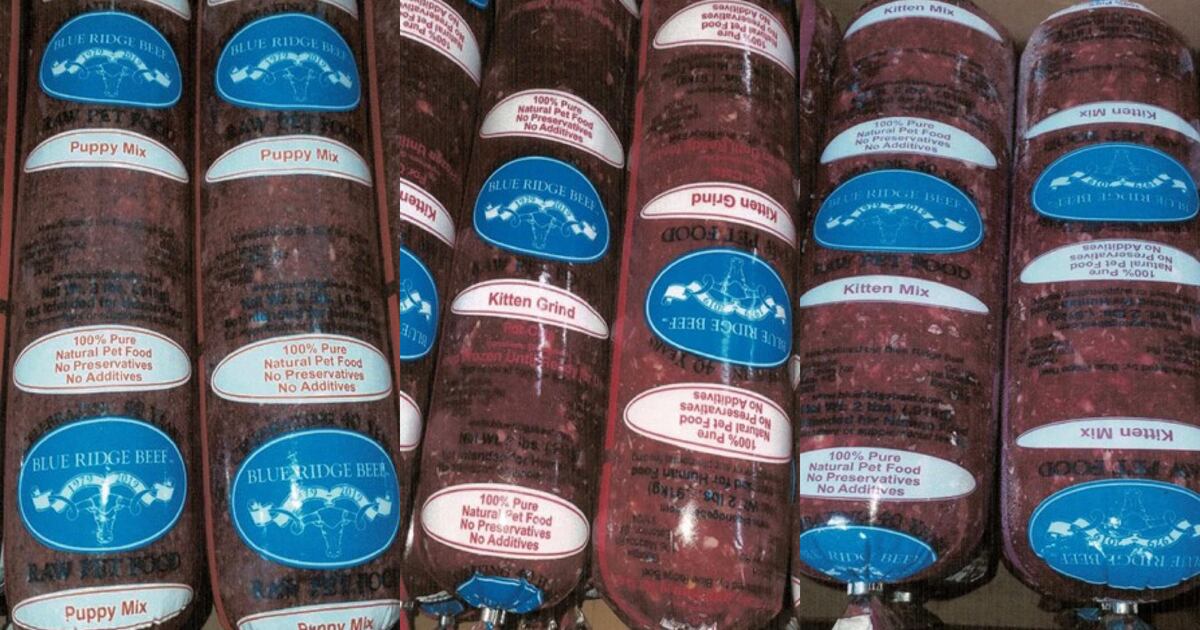
What Was Recalled
The blue ridge pet food recall announced in April 2025 covers two specific products manufactured by Blue Ridge Beef in Statesville, North Carolina. Both products are raw, frozen pet food sold as 2-pound logs in clear plastic packaging. The lot numbers are stamped on the clip ends of each bag, according to the FDA recall notice.
| Product | Size | Lot Number | Quantity Recalled | Contaminants |
|---|---|---|---|---|
| Blue Ridge Beef Puppy Mix | 2 lb logs | N25 1230 | 1,380 lbs | Salmonella, Listeria |
| Blue Ridge Beef Kitten Mix | 2 lb logs | N26 0114 | 1,080 lbs | Salmonella, Listeria |
Combined, the recall covers 2,460 pounds of pet food. The products were packaged in clear plastic and sold primarily through retail stores, not direct-to-consumer online channels. If you have either product at home, check the clip end of the bag for the stamped lot number before feeding.
Why the Recall Happened
The recall was triggered by a customer complaint of animal illness, as reported by Food Safety News. Following the complaint, the New York State Department of Agriculture and Markets collected product samples on March 20, 2025. Those samples were sent for laboratory analysis, and on April 1, 2025, the North Carolina Department of Agriculture confirmed that both the Puppy Mix and Kitten Mix tested positive for Salmonella and Listeria monocytogenes.
Blue Ridge Beef announced the voluntary recall on April 10-11, 2025. As of the recall announcement, no confirmed human illnesses had been reported in connection with these specific lot numbers.
What Are Salmonella and Listeria?
Salmonella is a group of bacteria that causes salmonellosis, one of the most common foodborne infections. It thrives in raw animal products and can survive in frozen foods. Symptoms in humans typically appear within 12 to 72 hours of exposure.
Listeria monocytogenes causes listeriosis, a more rare but often more serious infection. Unlike most bacteria, Listeria can grow at refrigerator temperatures. Symptoms may take up to 70 days to appear, making it particularly dangerous because people may not connect their illness to the source. Listeria is especially threatening to pregnant individuals, newborns, elderly adults, and anyone with a weakened immune system.
Finding both pathogens in the same product is uncommon and points to potentially systemic contamination issues in the production environment.
Affected States and Distribution
The recalled Puppy Mix and Kitten Mix products were distributed between January 3 and January 24, 2025, and were sold primarily in retail stores. According to the FDA, the following nine states received the affected products:
| State | Region |
|---|---|
| Virginia | Southeast |
| Maryland | Mid-Atlantic |
| Pennsylvania | Mid-Atlantic |
| Connecticut | Northeast |
| Massachusetts | Northeast |
| New York | Northeast |
| Tennessee | Southeast |
| Rhode Island | Northeast |
| Wisconsin | Midwest |
If you purchased Blue Ridge Beef raw pet food from any retail store in these states during January 2025, check your freezer for the recalled lot numbers even if you have already opened and partially used the product.
Health Risks for Pets
Pets that consume food contaminated with Salmonella or Listeria can develop serious illness. The Cambridge Public Health Department outlines the following symptoms to watch for in dogs and cats:
- Lethargy and decreased energy levels
- Diarrhea, which may be bloody
- Fever
- Vomiting
- Decreased appetite or refusal to eat
- Abdominal pain or visible discomfort
One particularly dangerous aspect of Salmonella in pets is that healthy-appearing animals can still be carriers. A dog or cat may show no symptoms at all while actively shedding Salmonella bacteria in their stool, saliva, and on their fur. This means the animal can transmit the bacteria to other pets in the household, to children who play with the pet, and to adults who handle the animal or clean up after it.
If your pet consumed any of the recalled products and shows any of these symptoms, contact your veterinarian immediately. Even if your pet appears healthy, mention the recalled food at your next vet visit so the veterinarian can monitor for delayed symptoms.
Health Risks for Humans
Humans do not need to eat the recalled pet food to become ill. Simply handling contaminated raw pet food, touching contaminated pet bowls or surfaces, or interacting with an infected pet can transmit Salmonella and Listeria to people, according to the FDA.
Salmonella Symptoms in Humans
Symptoms typically appear within 12 to 72 hours of exposure and may include:
- Nausea and vomiting
- Diarrhea or bloody diarrhea
- Abdominal cramping
- Fever
In rare cases, Salmonella can cause more severe complications including arterial infections, endocarditis (infection of the heart lining), arthritis, and urinary tract infections. Most healthy adults recover without treatment within 4 to 7 days, but the infection can be life-threatening for vulnerable populations.
Listeria Symptoms in Humans
Listeria monocytogenes presents a different risk profile. Symptoms may take up to 70 days to appear after exposure, as noted by Food Safety News, making it difficult to trace the source. Symptoms can include:
- Fever and muscle aches
- Headache and stiff neck
- Confusion and loss of balance
- Nausea, vomiting, and diarrhea
Who Is Most at Risk?
The Cambridge Public Health Department specifically warns that these groups face elevated risk:
- Children under 5, whose immune systems are still developing
- Pregnant individuals, particularly for Listeria, which can cause miscarriage, stillbirth, or serious newborn illness
- Adults over 65
- Immunocompromised individuals, including those undergoing chemotherapy, organ transplant recipients, and people living with HIV/AIDS
If anyone in your household is in a high-risk category and has had contact with the recalled products, consult a healthcare provider even if no symptoms are present.
What to Do If You Bought This Product
If you have Blue Ridge Beef Puppy Mix (Lot #N25 1230) or Kitten Mix (Lot #N26 0114) in your home, the FDA recommends the following steps:
- Stop feeding the product immediately. Do not give it to your pet, other animals, or any person.
- Return the product to the retailer where you purchased it for a full refund, or destroy it safely in a way that children, pets, and wildlife cannot access it. Double-bag the food before placing it in a sealed trash container.
- Do not sell or donate the recalled product.
- Wash and sanitize all pet food bowls, scoops, storage containers, and any surfaces the food may have touched. Use hot soapy water followed by a sanitizing solution.
- Wash your hands thoroughly with soap and warm water for at least 20 seconds after handling the recalled product or any items it contacted.
- Monitor your pet for symptoms including lethargy, diarrhea, vomiting, fever, or loss of appetite. Contact your veterinarian if any symptoms appear.
- Monitor yourself and family members for gastrointestinal symptoms, especially if anyone in your household is in a high-risk group.
Contact Information
For questions about the recall, contact Blue Ridge Beef directly:
- Phone: 704-873-2072 (Monday through Friday, 8:00 AM to 5:00 PM EST)
- Email: blueridgebeefnc@yahoo.com
Blue Ridge Beef Recall History: A Pattern of Repeated Contamination
The April 2025 blue ridge pet food recall is not a one-time event. Blue Ridge Beef has issued at least five separate recalls since October 2023, all involving Salmonella contamination, with the most recent also including Listeria. This pattern has raised concern among pet owners, veterinarians, and food safety regulators, as reported by Pet Food Industry, which noted this was the company's third Salmonella recall in just two months at one point.
| Date | Product | Lot Number(s) | Quantity | Contaminant | Trigger |
|---|---|---|---|---|---|
| Oct 2023 | Breeders Choice 2# Dog Food | 8/2/24 | Not disclosed | Salmonella | FDA testing |
| Dec 2, 2024 | Puppy Mix (2 lb logs) | 08/06/N25 & 08/16/N25 | 9,600 lbs | Salmonella | Customer's sick puppies |
| Jan 2025 | Kitten Mix (2 lb logs) | N25-0716 | 1,350 lbs | Salmonella | MA Dept of Ag sample |
| Feb 5, 2025 | Natural Mix (2 lb logs) | N25/12/31 | 5,700 lbs | Salmonella | NC Dept of Ag testing |
| Apr 10-11, 2025 | Puppy Mix + Kitten Mix (2 lb logs) | N25 1230, N26 0114 | 2,460 lbs | Salmonella + Listeria | NY Dept of Ag sample |
In total, Blue Ridge Beef has recalled more than 19,000 pounds of pet food across these incidents. Every single recall has involved Salmonella, and the most recent one added Listeria to the list. The December 2024 recall alone accounted for 9,600 pounds, triggered after a customer reported an entire litter of puppies becoming ill, according to the FDA's December 2024 recall notice.
Multiple state agriculture departments, including those in New York, North Carolina, Massachusetts, and Virginia, have been involved in testing and triggering these recalls. The fact that contamination has been found repeatedly across different products and lot numbers suggests the issue may extend beyond isolated batches.
Raw Pet Food Safety: The Bigger Picture
The blue ridge pet food recall is part of a broader pattern of contamination issues across the raw pet food industry. Raw pet food, by definition, does not undergo the cooking or pasteurization processes that kill harmful bacteria, making it inherently more vulnerable to pathogen contamination than kibble or canned food.
Other Recent Raw Pet Food Recalls
Blue Ridge Beef is far from the only raw pet food brand to face recall issues in recent months:
- Viva Raw (August 2025): Recalled two lots of dog and cat food for Salmonella and Listeria contamination, affecting Ground Beef for Dogs, Beef and Turkey for Puppies, Ground Chicken for Dogs, Chunked Chicken for Dogs, Chicken for Cats, and Pure Chicken products, according to the FDA.
- Raw Bistro Pet Fare (October 2025): Voluntarily recalled frozen Beef Entree dog food due to possible Salmonella contamination, per the FDA recall notice.
- Answers Pet Food: Received an FDA warning letter after inspectors found Salmonella and Listeria at their facility.
FDA's Position on Raw Pet Food
The FDA does not endorse feeding raw diets to pets. The agency has conducted multiple studies finding that raw pet food is significantly more likely to be contaminated with disease-causing bacteria than conventional pet food. The FDA's Get the Facts page on raw pet food states clearly that these diets "can be dangerous to you and your pet."
If you currently feed raw food and are reconsidering after this recall, consult your veterinarian about transitioning to a cooked, commercially processed, or freeze-dried alternative that better controls for pathogen risk. Our Best Freeze Dried Dog Food guide covers options that preserve nutritional density while reducing contamination risk.
What Pet Owners Are Saying
The recurring nature of the blue ridge pet food recall has generated significant concern among pet owners across online communities and social media. Many raw feeding advocates are grappling with the tension between the perceived nutritional benefits of raw diets and the undeniable safety risks exposed by repeated contamination events.
Common themes in pet owner discussions include:
- Frustration with repeat offenders: Pet owners have pointed out that five recalls in 18 months from a single manufacturer suggests systemic quality control failures, not isolated incidents. Many are questioning why the company is still allowed to operate without more aggressive FDA intervention.
- Concern about silent carriers: The fact that pets can carry and shed Salmonella without showing symptoms has alarmed multi-pet households and families with young children. Several pet owners have reported proactively testing their pets after learning about the recall.
- Calls for better labeling and tracking: Raw pet food consumers are asking for clearer lot number placement, better recall notification systems, and more transparent testing protocols from manufacturers.
- Re-evaluating raw feeding: Some long-time raw feeders are reconsidering their approach entirely, citing the difficulty of verifying safety when contamination events are discovered months after distribution. Others are shifting to brands with more rigorous third-party testing programs.
The raw pet food community generally supports the principle of raw feeding but acknowledges that manufacturer accountability and safety standards need significant improvement, as covered by CBS News in their recall coverage.
How to Stay Informed About Pet Food Recalls
Pet food recalls happen more frequently than most owners realize. Here is how to stay ahead of them:
- Bookmark the FDA recall page: The FDA's Animal & Veterinary Recalls page is the most authoritative source for pet food recall information in the United States.
- Sign up for FDA email alerts: The FDA offers free email notifications for new recalls so you do not have to check manually.
- Check lot numbers immediately after purchase: Get in the habit of noting the lot number and production date of every pet food product you buy. Photograph the label and bag clip for your records.
- Follow your state agriculture department: As seen in the Blue Ridge Beef recalls, state departments of agriculture in New York, Massachusetts, North Carolina, and Virginia played critical roles in detecting contamination before the FDA issued formal recalls.
- Monitor trusted pet food news sources: Sites like Pet Food Industry and Food Safety News often report recalls with additional context before mainstream media picks them up.
Related Guides
Frequently Asked Questions
What products are included in the Blue Ridge pet food recall?
The most recent recall covers Blue Ridge Beef Puppy Mix (2 lb logs, Lot #N25 1230) and Blue Ridge Beef Kitten Mix (2 lb logs, Lot #N26 0114). Both tested positive for Salmonella and Listeria monocytogenes. Check the clip end of the bag for the stamped lot number.
Which states are affected by the Blue Ridge Beef recall?
The recalled products were distributed between January 3 and January 24, 2025, to retail stores in Virginia, Maryland, Pennsylvania, Connecticut, Massachusetts, New York, Tennessee, Rhode Island, and Wisconsin.
What should I do if I bought recalled Blue Ridge Beef pet food?
Stop feeding the product immediately. Return it to the retailer for a refund or destroy it safely by double-bagging and sealing in trash. Wash and sanitize all pet bowls, scoops, and surfaces. Monitor your pet for symptoms like diarrhea, vomiting, lethargy, or fever and contact your veterinarian if any appear.
Can Salmonella in pet food make humans sick?
Yes. Humans can contract Salmonella by handling contaminated pet food or touching surfaces and objects the food has contacted. Symptoms include nausea, vomiting, diarrhea, abdominal cramping, and fever, typically appearing within 12 to 72 hours. Children, elderly individuals, pregnant people, and immunocompromised individuals face the highest risk.
How many times has Blue Ridge Beef recalled pet food?
At least five times since October 2023, covering Puppy Mix, Kitten Mix, Natural Mix, and Breeders Choice products. The combined total exceeds 19,000 pounds of recalled pet food, all involving Salmonella or Listeria contamination.
Is raw pet food safe to feed my dog or cat?
Raw pet food carries a higher inherent risk of bacterial contamination than cooked or processed alternatives. The FDA does not endorse raw pet food diets. If you choose to feed raw, practice strict hygiene, buy from brands with transparent third-party safety testing, and stay current on recall alerts.
Final Verdict
The blue ridge pet food recall underscores a reality that every pet owner feeding raw food needs to take seriously: contamination risks are not hypothetical, and repeat incidents from the same manufacturer point to deeper quality control problems. With more than 19,000 pounds of product recalled across five separate events, Blue Ridge Beef's track record demands caution.
If you have any of the recalled products, act immediately: stop feeding, sanitize everything, and watch for symptoms in both your pets and your family. For pet owners reconsidering their feeding approach, speak with your veterinarian about alternatives that balance nutritional goals with verifiable safety standards. Your pet's health and your family's safety depend on staying informed and acting quickly when recalls like this one occur.